Warrioir Body Drawing From Mid Evil Times
Medieval and Renaissance Literature
 |
| Chaucer's Pilgrim |
Timeline:
55BC-410: Latin speaking Romans occupy England
450: Romans withdrew from England and Germanic tribes (Angals and Saxons) invade
577: England converts to Christianity
800: Wave of Viking invasions
1006-1087:
k: Approximate year Beowulf was written
1066: Norman invasion of England
1075: Pope Gregory Seven declares the supremacy of the church
-King William the Conquistador was in ability, died in 1087
1087-1135:
1087-1110: Reign of Rex William Rufus
1110-1135: King Henry I
1099: Showtime Crusade
1135-1154:
King Stephen
1147: 2d Cause
1154-1189:
Rex Henry Ii
1170: Thomas Becket murdered in Canterbury Cathedral
1189-1199:
Rex Richard I
1190: Tertiary crusade
1199-1216:
King John
1200: Fourth Crusade:
1212: Children's Crusade
1215: Magna Carta Signed
1216-1272:
King Henry 3
1263-1267: The Barons war
1272-1307:
Rex Edward I
1337-1453: Hundred Years War
1360-1485:
Chaucer, Piers Plowman, Sir Gawain and the Dark-green Knight
I of the first books printed in England, Monte D'Arthur by Sir Thomas Malory
1425: Mystery Plays
1431: Joan of Arc Burned
1432: The Book of Margery Kempe
1475: The Shepard'due south Play
1485: William Caxton prints offset successful book in England
1486-1575:
1455-1485:
War of the Roses
Lowest
Sir Thomas Wyatt
1485/1509: Accession of Henry VII
1517: Showtime of Reformation
1575-1603
Sir Walter Raleigh
Sir Philip Sydney
1588: Defeat of Castilian Fleet
Christopher Marlowe
Spenser The Faerie Queen
1603-1660
Male monarch James I: first of Stuart Kings
Shakespeare: Hamlet
1612: Death of Prince Henry
1616: Death of Shakespeare
1618: xxx Years War
King Charles I
Shakespeare, plays and sonnets
John Donne Poems
1642: Civil War
1648: Second Civil War
1649 Charles I executed
1667 Paradise Lost
Introduction
Medieval Overview
Although there is no official consensus regarding the exact first and finish of the Medieval Period, it is most commonly associated with the collapse of the Roman Empire, around the 5th century, and leading upward all the mode to the 15th century, which is widely considered (though the exact beginning is disputed) the first of the Renaissance Period. This time catamenia is commonly known as The Center Ages was commonly regarded by Renaissance thinkers as "The Dark Ages."
On the continent, the development of Medieval literature–stemming from the preservation of culture and heroic adventures within epic poems–is a direct result of Charlemagne'south desire to educate his people in 800, which was only fabricated possible through an emphasis on the teachings of the Catholic Church. The Catholic Church building created schools with an intensive curriculum founded upon the education of grammar, rhetoric, Latin, astronomy, philosophy and math. Christianity was legalized by the Roman Empire during the Fourth Century, and every bit a result, education as well as laws were overseen by the Church. The Church often wielded more power than the oft-weak feudal monarchies that characterized medieval society.
In the 12th Century, in that location arose a potent presence of chivalry in Medieval order which rapidly inhabited the literature of the time; the chivalric code was a moral code, or rather, a code of deport bound to duty, honor, and justice. Reflected inside the texts of the time–the ways in which characters are affected by loyalty, duty, and honor–the chivalric code was both a necessary platform for knighthood and skillful moral standing. The presence of chivalry in Medieval Culture is exemplified in the representation of a just and moral knight facing temptation and conflict in Sir Gawain and the Greenish Knight. Every bit a outcome of the presence of chivalry, ladylike love gave rise to an increased product and contemplation of romantic prose. While the printing press was invented in the Fifteenth Century, its impact was not fully accomplished until the Renaissance. citations?
The Middles Ages can be dissever into three periods: the Early on Middle Ages, the High Heart Ages, and the Belatedly Middle Ages.
The Early Eye Ages typically signify the begging of the Medieval Era with the fall of Rome and continue until sometime in the 11th century. Anglo-Saxon tribes invaded England around 450 and they had a vast touch on literature. The linguistic communication of theseinvaders is classified as Erstwhile English and is widely represented in Anglo-Saxon poesy (UMASS). Former English verse was passed down orally before it was written. The earliest written example is found in the writing of Bede and his poem Caedmon's Hymn. The Anglo–Saxon's helped further spread Christianity by adapting to information technology; however, Anglo-Saxon poetry contains a thematic "heroic code" which blends with and sometimes contradicts Christian ideals. The "heroic code" places value on kinship, and emphasizes duty and vengeance for 1's lord (Norton). I of the almost popular Old English epic poems is Beowulf, which follows arrange of its relative Germanic literature with its heroic and Christian themes.
The High Eye Ages are thought to have begun around The Norman Invasion. Linguistically, this era brought near the transition from Former
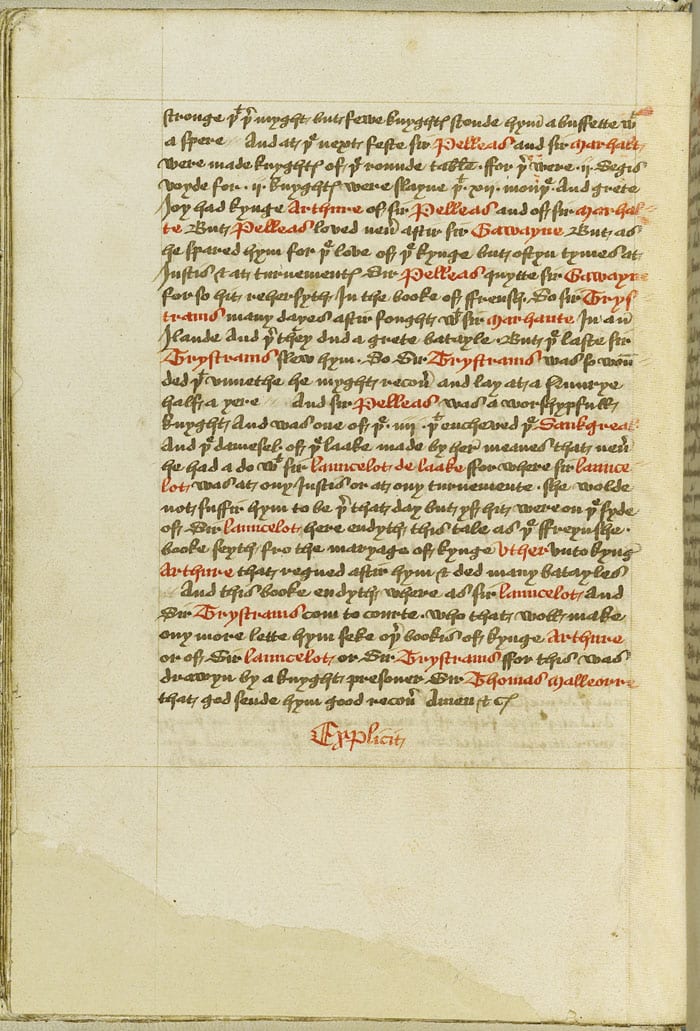 |
| The final page in Caxton'south print of Morte Darthur. Prototype courtesy of The British Library. |
English to Eye English, feudalism, and the Medieval "romance" which came from the French speaking Anglo-Normans. Romances characteristically revolve around similar themes of members of the lower dignity trying to rise in status, the young inbound adulthood and their fears, and individuals existence cast out of order and returning as part of a stronger unit of measurement. Th
east most popular romantic effigy of this time is the character of Rex Arthur who arose in the 13th century. The Arthurian romance contains the chivalric code, involving knights, run a risk, and honor (LordsandLadies.org). Other pop romances of this time include Sir Gawain and the Dark-green Knight, Geoffrey Chaucer'due south The Canterbury Tales, and William Langland's Piers Plowman.
The Late Eye Ages mark the end of the Medieval era, which is estimated to have ended around 1485, the year Henry VII ascended to the throne, and the
Tudor dynasty began. This era independent the Hundred Years War, which ended in 1453, and the Blackness Death, which eliminated well-nigh one-third of Europe's population. In 1485, William Caxton introduced England to the art of press books, when he published Sir Thomas Malory's Morte D' Arthur (Norton).
Function of Faith
A medieval church in Rome.
Image courtesy of:
http://cameronkirwan.wordpress.com/2012/12/

Co-ordinate to the History Learning Cite, the Church was absolutely the most important part of medieval society. "The Church building dominated everybody's lives." The only religion that existed was Christianity. All medieval people, regardless of their social rank, believed in God, Heaven, and Hel l, however information technology was strongly believed that the only mode they could go to Heaven is if the Roman Cosmic Church allowed them. Similar to today, Hell was depicted as every person's worst nightmare, and Heaven was eternal paradise.
There are many reasons that the Church building was and then ascendant during medieval times, but a principal reason is its extreme wealthiness. The Church made money whatsoever way they could, only they made majority of their money through tithes. A tithe is a tax that is one 10th of a persons yearly earnings or appurtenances that had to be given to the Church building. Peasants obviously found it very difficult to pay tithes because they take problem making fifty-fifty enough money for themselves, and so they had to pay with seeds or grain. It was non an choice to not pay a tithe considering it was told that the punishment of non paying a tithe would outcome in eternal damnation. Other ways the Church became so wealthy was their constant charges for receiving sacraments. If one wanted to be baptized, married, or buried there was a charge, and someone becoming baptized and beingness cached on Holy Ground was another way to get to Heaven. Marriage was very different in the medieval ages. Married couples were not immune to alive together considering information technology was viewed as a sin. With all of this income from basically every person in society the
Church was extremely well-off, and to keep the Church building equally wealthy as possible they did not have to pay any taxes. It is said that The Church building was wealthier than any male monarch in the world during this time menstruation, and they saved well-nigh of their money. However, the money that they did spend was on their structures such as churches or cathedrals. http://world wide web.historylearningsite.co.great britain/medieval_church.htm
The actual construction of the Church was the middle of all community activities. People would perform plays and there were always markets held exterior of the Church. The Church was viewed every bit having the answers to everything and anything that would happen, especially when something bad happened. If there was a bad tempest or an outbreak of disease, the church was supposed to know why. The language of the Church building, Latin, was the but common language spoken in all of Europe. Anyone who did not know Latin would not be able to communicate. This just proves how important the Church truly was. They determined the language of an entire continent. The Church held entirely all of the power in medieval times, and was very well-respected.
http://www.dcts.org/academics/documents/RomanCatholicChurchinMedievalEurope.pdf
Literary Genres in the Medieval Period (5th-15th Centuries)
Nigh scholars associate the offset of the medieval period with the autumn of the Roman Empire in 410AD. Subsequently the Romans withdrew, Germanic tribes invaded and spread their influence into England.
http://courseweb.stthomas.edu/medieval/chaucer/literarygenres.htm
Old English Menses
Oral Poesy: There are not many recorded works from the Old English Period primarily considering of the scarcity of people who were literate (mostly express to clergy members). Oral poesy mainly carried Christian themes (since nil was written down until there was heavy Christian influence we do not know if these religious undertones were role of the original work), and often centered on the adventures of swell heroic figures. It was passed downwards over generations, which caused it to exist continuously changed with each retelling. We may never know many peachy works of oral poesy, notwithstanding, information technology played a large role in impacting subsequently written works. Most of Quondam English language Poesy is contained in just four manuscripts, for instance, "The Wanderer."
http://www.uncp.edu/abode/canada/work/allam/general/glossary.htm
 |
| Oral poesy was commonly accompanied by the music of a harp. Image Courtesy of: http://cafe.themarker.com/epitome/1676379/ |
Early Middle English language Period
Germanic Heroic Verse: It started out being performed orally in alliterative poetry but was later written downward past scholars or clergymen. Oftentimes it was used to depict current events, and touched on themes, which invoke the aboriginal code of laurels that obliges a warrior to avenge his slain lord or die beside him. They show the aristocratic heroic and kinship values of Germanic society that connected to inspire both clergy and laity. The effect of language in Germanic Heroic Poetry and Quondam English Poetry was to formalize and drag speech.
Anglo Saxon Literature:
Elegy: It is typically mournful or sad. Information technology can be in the grade of a funeral song o a lament for the dead. For example: "The Wanderer"
Centre English Literature:
Romance, Courtly Romance: This was the almost popular genre in the Middle English period; it had a particular story structure that depicted the integration, disintegration, and reintegration of a fundamental hero. Usually the hero underwent a exam or claiming that alienated them from society. It is outside the world of every twenty-four hour period experience or unnatural/magical. Information technology was the principal narrative genre for late medieval readers and centrally concerned with love but it developed means of representing psychological interiority with great subtlety. Though they began in France, their transition into English literature came about from simplified and translated versions of the original French works. Frequently, Romances, whether written for aristocratic audiences or lower class audiences, had to do with a knight attempting to win the dear of a woman of much higher class, past showing the depth of his character through acts of morality, nobility, and bravery.
– A sub-genre of the romance was the Arth urian Fable: Stories that told nigh the legend of King Arthur and his Knights of the Round Tabular array.
– For example: Sir Gawain and the Green Knight
https://www.britannica.com/shakespeare/article-12775
 |
| King Arthur and his knights of the round table. Image Courtesy of: http://merryfarmer.net/tag/arthurian-legend/ |
Allegory: An extended metaphor—where something is standing for something else. Information technology is a depiction of a mutual theme. An allegory tells a story that has characters, setting, and other symbols that serve both a literal and figurative purpose and point out a theme about human life. For Case, Piers Plowman or Lowest
Estates Satire: Represents the 3 estates, the clergy, the nobility, and everyone else. It satirizes society with the purpose of presenting the flaws of something in an exaggerated way with the intent of cartoon attention to create a solution for it. It examines order by groups based on class, occupation, function, condition and other designations. For Example: The Canterbury Tales
Middle English lyrics: A type of secular verse. They were generally dearest poems although some were almost social satire or the celebration of earth and humanity; they were very passionate and not nigh God. The lyrics exercise non tell a long story (not an ballsy, odyssey, ballad) but rather well-nigh a unmarried idea or image. They have a very contemporary rhyme scheme and subject area thing.
Autobiography: Merely as autobiographies today tell the story of a person's life through their point of view, early autobiographies did the same thing. They generally depicted the trials and triumphs of a person'south life and their internal thoughts nigh the matter. The starting time autobiography was The Book of Margery Kempe.
Drama: For the most role, drama rose to popularity in the later medieval period (1000-1500). Early dramas were typically very religious in theme, staging and tradition. Performance of plays outside of the church became pop around the 12th century when they became more widely accessible to the full general population. Plays were commonly performed by a professional acting visitor that traveled from town to town on wagons and moving stages. Most theater companies were exclusively male. The Second Shepherds' Play
Morality Play: A type of drama that emerged around 1400 and became increasingly popular through out the century. They taught lessons about morality and homo nature and used emblematic characters to portray the struggle that a person goes through to achieve salvation and the forces of proficient and evil. A morality tale could have had either a serious or a comic plot.
– The Erect and the Play a joke on, Everyman
http://www.essential-humanities.internet/western-art/literature/medieval/
http://www.thefreedictionary.com/Morality+tale

Depiction of a mystery play performance.
Image courtesy of http://www.props.eric-hart.com/
Religious Prose: Sought to explain the great truths of god, humanity, and the universe through an analysis of Christian beliefs, focuses on sin, penance, and love.
– For Example: Margery Kempe
http://www.britannica.com/EBchecked/topic/188217/English-literature/12775/Religious-prose
Secular Literature
At that place are few examples of secular work during the Medieval menstruum as a upshot of the influence of organized religion inside society. Secular Poetry was ane of the main works of literature at this time. It was full of satire and irony concerning everyday life. The incline of popularity of these secular works led into the Renaissance. An important example of this blazon of poetry is The Canterbury Tales by Geoffrey Chaucer. Secular Medieval literature helped create a pathway for future authors in the Renaissance.
The Canterbury Tales is one of the most well known secular works from the Medieval period. Rather than focus on the Church and religion, The Canterbury Tales looks instead at other common ideas of the time, such every bit courtliness and visitor. This courtliness, or courtly dear, could exist found in many poems and other pieces of literature during this fourth dimension catamenia. Courtly love is when a woman is treated with utmost respect, care, and dear from a knight. He will exercise annihilation to make her happy, and her happiness and dear in turn makes the knight stronger and more than respected. In The Canterbury Tales, courtly love can be establish in the Knight'southward Tale, a story near ii knights who fall in honey with the same woman and must choose to award either the code of courtly love or the code of knightly. The theme of visitor is also present throughout the entire poem. It is clear in that the pilgrims are traveling together and sharing each other'due south company by learning about ane another and sharing stories. Below is a link to an blithe version of The Knight's Tale. Other themes mutual in Medieval secular poetry are spring, love, and politics. Many other satirized the community.
http://www.youtube.com/scout?v=deRyhTuny3w
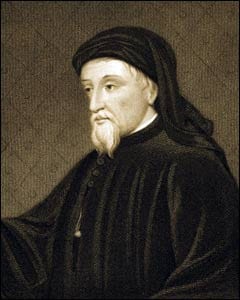
Geoffrey Chaucer
Image Courtesy of
http://world wide web.luminarium.org/medlit/chaucer.htm
.
As the Renaissance began to rise throughout Europe, secularism and humanism became increasingly popular. This time brought on "the appreciation of worldly pleasures, and higher up all the intensified assertion of personal independence and individual expression" (cite). Instead of focusing on the afterlife, people began focus on their electric current place in life. They looked towards themselves and who they were as individual people instead of solely people of God. This time in history tin can be seen as the showtime of the plow to reason and the loss of religion. Similar to secular literature of the Medieval catamenia, secular literature of the Renaissance focused on worldly things, such as spring and love. The reason function of this literary period inspired essays on human characteristics and politics, with Francis Salary existence one of the most writers of these types of essays.
Women in the Literature
Throughout the Medieval catamenia, women were viewed as second grade citizens, and their needs e'er were an afterthought. They were either held to be completely deceitful, sexual, innocent or incompetent. Therefore, women were mostly withheld from positions of ability or speaking their voice; males made decisions for them and their lives were dictated by the men that ran the society. Despite their lack of validation and suppression, however, women in Medieval literature were certainly nowadays in many works and in various forms. Some tropes feed into the idea that women are subservient and inferior to men such as the Virgin, which portrays females as passive and weak, or the mother whose very life circles around making a better life for her family unit and especially for her husband, or even the whore who has no power in her sexuality and must give it abroad for the well being of her family or the men in society. However, at that place are some archetypes that break this cycle like the Trickster or Witch who intermission the social norms and stand out, displaying qualities of cunning intelligence, intimidation, and power. The sections below will swoop deeper into the disparity between how women were viewed in Medieval gild and how they were portrayed in the literature of the fourth dimension.
Click to see More
Introduction to the Renaissance
As a whole, the Renaissance encompasses an incredibly large rebirth of noesis and learning that began in Italy in the fourteenth century. By the Sixteenth Century, Renaissance thinking spread from Italy, reaching north towards England. The advances in knowledge which identify the shift from Medieval Literature to Renaissance Literature were dependent upon a render to classical idea within the literature and philosophies of artifact. This return to classical ideas and worldview gave rising to Humanism, which asserted the value of man, his dignity, and his lack of limitations. As a outcome, there was a shift in emphasis from the contemplative life of the Medieval human to the involved life of the Renaissance man: well-rounded, active, and involved with the earth effectually him. Most notably, Humanists provided social club with a pervasive and overarching sense of humanity.
Renaissance Literature also mimicked changes in culture; turning abroad from primarily religious thinking and placing importance on classical idea, Renaissance thinkers conjured new philosophies from the teachings of Plato and Aristotle. Sexual love was seen as the presence of spiritual bonds in literature, arising from new constitute knowledge of Platonic dear. Some Neoplatonists believed in that location to be a link between attaining knowledge (as knowledge of science was seen every bit factual representations or understanding of the world) and human relationship with God or the Divine. Citation?
This shift in governing thought process led to a new earth view which negated the cosmic worldview present in Medieval Literature. While Renaissance thinkers would avoid drawing comparisons between themselves and the thinkers of the Middle Ages–"According to them, the Middle Ages were set in the "centre" of ii much more valuable historical periods, antiquity and their own."–similarities between the two are ever-present, specifically in regards to the remnants of Medieval worldview which extend its belief of The Bang-up Chain of Existence deep into Renaissance civilisation and literature. Citation The exaltation of man's power propagated by Humanism, created discomfort and confusion in light of The Corking Chain of Being. Since man'southward agency was believed to be limitless, his identify within The Great Chain of Being was complicated. This struggle of human aspiration within a world still governed by The Peachy Chain of Being is depicted within Christopher Marlowe's Doctor Faustus.
In the Sixteenth Century, as a upshot of systemic corruption within the Church (e.g., simony and the selling of indulgences), protestants desired reformation of the Church building. The Protestant Reformation, which the movement came to be, left Europe no longer united; the religious criticisms of Martin Luther fragmented the Church building earlier long–after gaining him excommunication from the Church–and gave ascension to Henry Viii's political separation of the Church of England from Rome. Through the rejection of the Church, the Reformation placed importance on the role of the individual, in that authority of religious teaching was reliant upon the text rather than the institution. With that being said, the renewed interest in the Bible a piece of literature led to its unforeseeable influence in modern literature, where Biblical allusions and symbols were experimented with; this influence is visible in the works of John Donne (Holy Sonnets), John Milton (Paradise Lost), and Andrew Marvell ("The Garden").
The spread of literacy and noesis throughout this period was profoundly influenced past the invention of Gutenburg'due south printing press, which slowly made the majority of literature more widely accessible.
Secular Works of The Renaissance
The Renaissance saw the finish of feudal rule, and fabricated efforts to plant a primal regime. This new prominence of politics–the rise and fall of kings–framed the narrative for many of Shakespeare's plays, also as Machiavelli's The Prince, a treatise on proper governing practices–all of which tend to hinge upon ruthless rule.
Women'due south Role During The Renaissance Menstruum
For the most part, women remained nevertheless remained somewhat suppressed in this time period. The fact that the new ruler was in fact, Queen Elizabeth, was upsetting to many.
"Many men seem to have regarded the chapters for rational thought as exclusively male; women, they causeless, were led only by their passions. While gentlemen mastered the arts of rhetoric and warfare, gentlewomen were expected to display the virtues of silence and good housekeeping. Among upper-class males, the will to dominate others was acceptable and indeed admired; the same volition in women was condemned as a grotesque and dangerous aberration." (The Norton Anthology: English Literature: The Sixteenth Century/The Early Seventeenth Century, Volume B)
Women also lacked the ability to attend schools and universities also. Although because of the importance of reading scripture in the Protestant organized religion, women's literacy did somewhat improve, nevertheless the ability to write was incredibly rare. Therefore, whatsoever works produced by women at this time are very scarce.

Portrait of Queen Elizabeth
Photo courtesy of Wikipedia
The Part of Organized religion During The Renaissance Period
At the showtime of the sixteenth century, Catholicism even so reigned as the principal religion in England. It yet dictated nearly every important decision in a person's life, and because virtually religious literature, virtually notably the Bible, was printed in Latin, the clergy members held a great deal of ability considering of their literacy to interpret these works. Notwithstanding, Martin Luther, a key effigy in the massive shift in religious civilization known equally "The Reformation", began to question the ideas of the Roman Cosmic Church. This idea quickly caught on, partly due to the ability to widely distribute material through the printing press, and spread like wildfire throughout Europe. Although the violent shift between Catholicism and Protestantism continued for several years, Queen Elizabeth eventually lead in a new era for England with her acceptance of the Protestant organized religion. The effect on literature at this time flow was profound, because when Catholicism was dominant, Protestant works remained underground, and vice versa for periods of Protestantism likewise.
Some of the about notable authors and poets of the time include Edmund Spenser, the Earl of Surrey, Sir Philip Sydney, Ben Jonson, Aemilia Lanyer, Robert Greene, and, of grade, William Shakespeare.
Literary and Cultural Contexts
Medieval Drama: Mystery and Morality Plays
The Elizabethan Theatre
The Development of the Book in Medieval and Renaissance Society
The Reformation and British Society
The Elizabethan Sonnet Sequence
The Medieval University
Literary Consciousness in Medieval and Renaissance Literature
Authors
John Donne
George Herbert
Richard Lovelace
Christopher Marlowe
Andrew Marvell
John Milton
Sir Philip Sidney
Edmund Spenser
Sir Thomas Wyatt the Elder
References
The American Heritage English Dictionary. "Morality Play." The Free Online Lexicon. Houghtan Mifflin Visitor, 2009. Web. December 5, 2013. <http://world wide web.thefreedictionary.com/Morality+tale>.
The British Library Digitized Manuscripts. Morte Darthur.
http://britishlibrary.typepad.co.uk/digitisedmanuscripts/2012/11/rediscovering-malory-digitising-the-morte-darthur.html
Baker, Peter. "English language Literature." Encyclopedia Britannica. Encyclopedia Britannica Inc., April 26, 2012. Web. December five, 2013. <http://world wide web.britannica.com/EBchecked/topic/188217/English-literature/12775/Religious-prose>.
"The Canterbury Tales: The Knight's Tale" Shmoop. Shmoop Academy, Inc. n.d. Web. 7 Dec 2013 <http://www.shmoop.com/knights-tale/>.
Chaucer'south Pilgrim. From the Ellesmere Manuscript. Wikimedia Commons.
https://sites.udel.edu/britlitwiki/files//2018/06/FileChaucer_ellesmere.jpg
"English Literature." Encyclopedia Britannica's Guide to Shakespeare. Encyclopedia Britannica Inc., 2013. Web. December v, 2013. <https://www.britannica.com/shakespeare/commodity-12775>.
Fletcher, Humphrey. "Medieval Literature." Essential Humanities. 2008. Spider web. Dec 5, 2013. <http://world wide web.essential-humanities.net/western-fine art/literature/medieval/>.
"Introduction to the Renaissance." Introduction to the Renaissance. N.p., n.d. Spider web. 06 Dec. 2012.
Kreis, Steven. "Renaissance Humanism." The History Guide: Lectures on Modernistic European Intellectual History. The History Guide, xiii April 2012. Spider web. 7 Dec 2013. <http://www.historyguide.org/intellect/humanism.html>.
"Medieval Society and Civilisation." Medieval Life & The Hundred Years War. Due north.p., 1994. Web. ane Dec. 2012.
St. Thomas Academy. "Medieval Literary Genres." Medieval Literary Genres. 2003. Web. December v, 2013. <http://courseweb.stthomas.edu/medieval/chaucer/literarygenres.htm>.
Smith, Nicole. "Representations of Women in Medieval Literature." Article Myriad. North.p., six Dec. 2011. Web. 01 December. 2012.
"The End of Europe'south Eye Ages." The End of Europe's Middle Ages – Linguistic communication & Literature. The University of Calgary, 1998. Spider web. 01 Dec. 2012.
"The Flow of History." The Italian Renaissance. Northward.p., n.d. Spider web. 06 Dec. 2012.
"The Medieval Church." The Medieval Church building. Northward.p., n.d. Spider web. 30 Nov. 2013.
"History Alive! The Medieval World." The Role of the Church in Medieval Europe. Due north.p., n.d. Spider web. 25 Nov. 2013.
"History Through and through." History Through and through. N.p., n.d. Spider web. 23 Nov. 2013.
"Medieval Literature" UMASS. http://people.umass.edu/eng2/per/medieval.html. Web. 25 Nov. 2013.
"THE Heart AGES: THE FEUDAL Organisation." ThinkQuest. Oracle Foundation, n.d. Spider web. 06 December. 2012.
"The Middle Ages" The Norton Anthology of English Literature. 8th Ed. Greenblatt, Stephen. New York, NY: W.W. Norton & Company. 2006. 1-23. Print. 25 November. 2013.
"Middle Ages" http://www.lordsandladies.org/index.htm. Web. 25 Nov. 2013.
"The Norton Anthology of English Literature: The Middle Ages: Book A: Introduction." N.p., due north.d. Web. 07 Dec. 2012
"The Norton Anthology of English Literature: The 16th Century: Introduction." The Norton Album of English Literature: The 16th Century: Introduction. N.p., due north.d. Web. 06 Dec. 2012.
Wilde, Robert. "Renaissance Timeline." European History. N.p., due north.d. Web. 01 Dec. 2012.
Source: https://sites.udel.edu/britlitwiki/medieval-and-renaissance-literature/
0 Response to "Warrioir Body Drawing From Mid Evil Times"
Post a Comment